After 17 Years, I Owe Every Pet Owner I Ever Spoke To An Apology. Here's What I Just Discovered About Ultrasonic Pest Control.
I'm a board-certified veterinarian. For nearly two decades, I told my clients ultrasonic pest devices were scams. I was right about most of them — and dangerously wrong about the rest. After testing 11 of them in an independent lab, I discovered something the pest control industry has kept from regular pet owners for 40 years.

You Were Right To Be Skeptical
If you've been thinking about ultrasonic pest repellers but the reviews scared you off, you were right to be cautious.
The FTC has been suing ultrasonic device companies for false advertising since 1985. Bell + Howell paid nearly $4 million in a class action lawsuit because their pest devices were proven to be "worthless." Kansas State University ran controlled studies showing the cheap consumer devices have little to no effect on common pests like fleas, ticks, and roaches.
I'm a board-certified veterinarian, and for 17 years I told my clients the same thing: "Don't waste your money on those ultrasonic devices. They're scams."
I was right about most of them.
But I was wrong about something far more important.
There's a category of ultrasonic technology that has been keeping hospitals, food processing plants, and luxury boarding kennels completely pest-free for over 40 years. I had no idea it existed.
Until last September, when I tested it myself.
What Happened When I Tested 11 Different Ultrasonic Pest Repellers
Last September, my own dog Beau — a 6-year-old Australian Shepherd — came home from a hike with a tick I missed. Three weeks later he was in the emergency veterinary hospital with Lyme disease. Fever of 105.4. Dropping platelet count. IV antibiotics. The whole nightmare.

While I was sitting in that hospital waiting room for six hours, I noticed something I had walked past dozens of times in my career and never paid attention to.
Mounted on the wall, about eight feet up, was a small white device with a digital frequency readout.
When the technician came out, I asked her about it.
"Oh, that's our pest disruption system," she said casually. "We have them all through the hospital. Surgical suites, kennels, waiting rooms, everywhere. We can't use chemical pesticides — contamination risk during surgeries."
I stared at her. "It's an ultrasonic pest device?"
"Variable-frequency sweeping system, yes. Why?"
"Because I've been telling my clients those don't work for 17 years."
She laughed. "The cheap consumer ones don't. Those are toys. This is commercial-grade pest control. We've been using these since 2014. Haven't had a flea, tick, or roach in this hospital in over a decade."
A decade.
In an emergency veterinary hospital that sees thousands of pets per year. From every possible flea-and-tick environment in the region. Zero infestations.
While my own dog was upstairs on IV antibiotics fighting a tick-borne disease that I could have prevented if I'd known this technology existed.
I felt sick.
When I got home from the hospital that week, I did something I should have done years earlier.
I bought 11 different ultrasonic pest devices from Amazon, Home Depot, and Walmart. The big-name cheap brands. I paid out of my own pocket to send them to an independent acoustics lab for testing.
The results were eye-opening.
-
11All 11 emitted ultrasonic waves of some kind. Technically, every device "works" in the sense it produces a sound above 20 kHz.
-
9Used fixed-frequency tones (22-28 kHz range). Fleas, ticks, and roaches adapt within 2-3 weeks. The device emits noise pests literally tune out.
-
1Emitted a wider frequency band but with no modulation. Slightly better, but still adaptable within a month.
-
1Emitted genuine variable-frequency sweeping that constantly shifts through ranges — impossible for insects to adapt to. Hospital-grade specifications. That last one was CritterX.
There Are Actually Two Completely Different Types Of Ultrasonic Devices
This is the part nobody explains.
When most people hear "ultrasonic pest repeller," they think of the cheap plug-ins they've seen on Amazon for $19.99. The ones with thousands of suspicious 5-star reviews. The ones where people post photos of mice literally sleeping on top of the device.
Those are real. They're scams. And the reviews calling them scams are accurate.
But that's not the only type of ultrasonic pest control that exists.
- Fixed-frequency design (one constant tone)
- Pests adapt within 14-21 days
- Cheap $3 internal components
- No real engineering — plastic shells with LEDs
- The category FTC has sued for 40 years
- Variable-frequency sweeping (22-65 kHz)
- Pests cannot adapt — signal never stays constant
- Hospital-grade transducer components
- Used in surgical wards & food plants
- The technology you never had access to
The cheap Amazon devices and commercial-grade systems are as different from each other as a kazoo and a concert violin. Technically both produce sound. But only one is engineered to actually do something.
The reviews you've been reading about scam devices? They're correct about Type 1.
They've never encountered Type 2 because for 40 years, this technology has only been available to commercial facilities at $8,000-$12,000 per installation.
How Variable-Frequency Sweeping Technology Actually Works
I want to be technical here for a moment because this is the part that matters.
Standard cheap ultrasonic devices emit a fixed frequency — usually around 25 kilohertz. Imagine playing the same musical note on a piano, over and over, for the rest of your life. At first it's annoying. After two weeks, your brain stops registering it entirely.
That's exactly what happens to fleas, ticks, and roaches with fixed-frequency devices. Within 14-21 days, they've adapted to the constant tone. The device might as well be unplugged.
Variable-frequency sweeping technology is fundamentally different.
Instead of one constant tone, it cycles through four distinct frequency ranges:
And critically: the device sweeps between these frequencies in random, unpredictable patterns. The signal never stays constant. Pests cannot adapt because there's nothing consistent to adapt to.
This is the same technology hospitals have used since the 1980s. It's why surgical wards can stay pest-free without using chemical pesticides that would contaminate operating rooms. It's why food processing plants can pass FDA inspections without spraying poisons that would touch food.
It works because of physics. Not marketing.
What Industries Use This Technology (And Why)
I spent two weeks researching commercial pest control after I learned about CritterX. Here's what I found.
Hospital operating rooms use variable-frequency ultrasonic systems because chemical pesticides would contaminate surgical environments. A single pest near a surgical patient could trigger a fatal infection. They cannot use sprays or fogs. They need something that physically disrupts pest activity without introducing chemicals.
Pharmaceutical manufacturing facilities use the same technology because the FDA requires zero contamination tolerance in clean rooms. A single insect in a pharmaceutical production line means an immediate shutdown, product destruction, and possibly federal investigations. The cost of failure is catastrophic.
Food processing plants use it because pesticides cannot legally come in contact with food products. Yet a single pest in the production line can trigger recalls, lawsuits, and FDA enforcement actions worth millions of dollars.
Luxury boarding kennels use it because they cannot medicate hundreds of rotating dogs against fleas and ticks. Each pet boarder might be on a different medication regime, or no medication at all. They need an environmental solution that protects every pet without requiring individual treatment.
These industries aren't gullible consumers buying $19.99 Amazon plug-ins.
These are facilities where pest control failure means lawsuits, bankruptcies, FDA shutdowns, or patient deaths.
They wouldn't use the technology if it didn't work.
The only reason consumers never knew about this is because commercial installations cost $8,000-$12,000. They were sold to facility managers, not pet owners. The technology existed for 40 years but was completely inaccessible to anyone who wasn't running a commercial operation.
Until now.
How CritterX Was Built
CritterX exists because of a former commercial pest control engineer named David Chen.

For 15 years, David installed those $10,000 variable-frequency ultrasonic systems in hospitals, food processing plants, and boarding facilities. Every installation, he'd watch facility managers solve their pest problems completely without chemicals.
And every time, he'd think the same thing: Why is this technology locked away from regular pet owners?
The components weren't actually that expensive. The proprietary engineering was. Commercial pest control companies kept the designs locked behind massive price tags and B2B distribution.
David spent three years reverse-engineering commercial systems into a consumer-priced device. Same variable-frequency sweeping technology. Same hospital-grade transducers. Same fundamental engineering that protects surgical wards and food production lines.
Just sized for a home instead of a 50,000 square foot facility.
He called it CritterX.
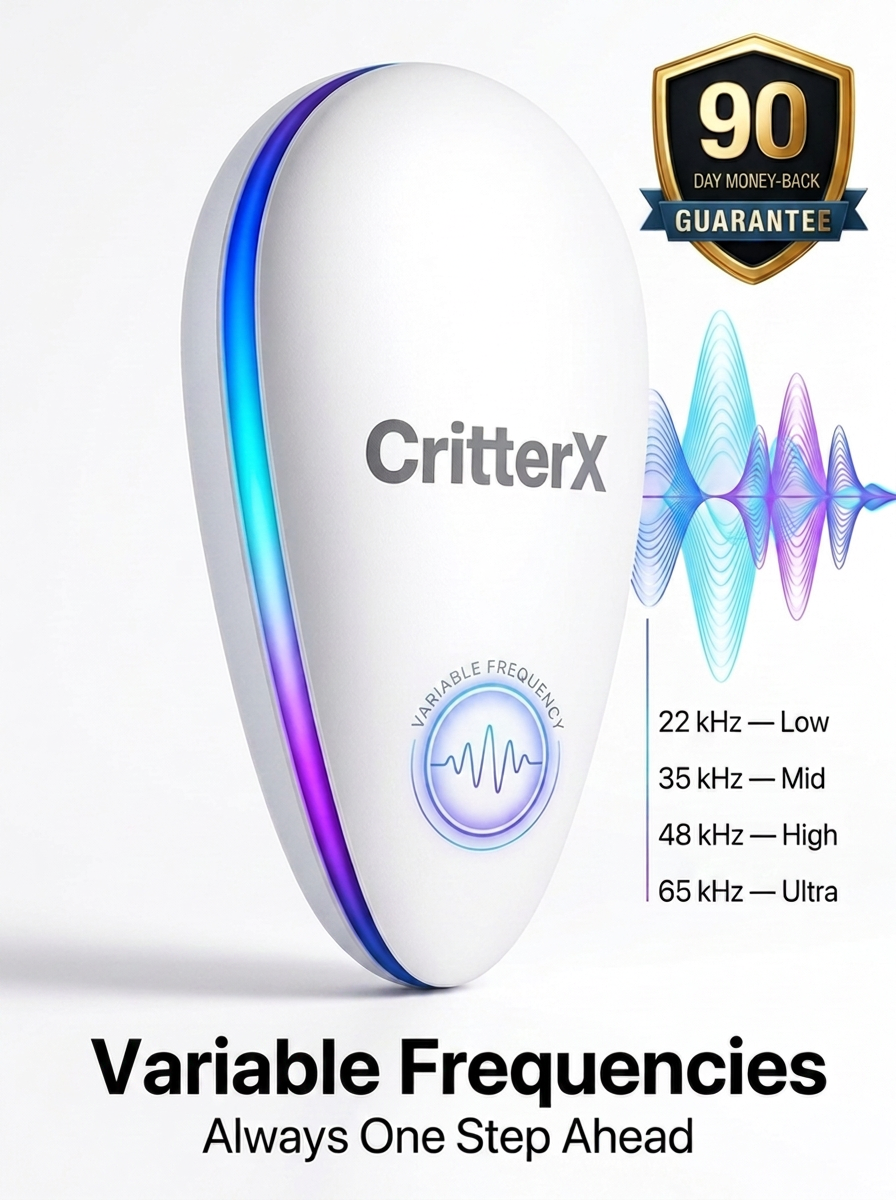
CritterX Pro Advanced Pest Repeller
Variable-frequency sweep technology · Hospital-grade transducer · 400 sq ft coverage · 4-5 year lifespan · 90-day money-back guarantee
When I tested CritterX in that independent acoustics lab last September, the results matched the marketing claims exactly. Genuine variable-frequency sweeping. Hospital-grade transducer specifications. Real engineering — not the cheap plastic shells with LED lights that fill Amazon listings.
I bought two more units from different production batches to verify. Both came back with identical results.
I started recommending CritterX to my long-time clients about 11 months ago.
Better than any chemical flea and tick treatment I've recommended in 17 years. And better than any of the cheap ultrasonic devices I've ever encountered.
What Former Skeptics Are Saying
I want to share three stories from clients who started exactly where you might be right now — convinced ultrasonic devices were scams.
Three former skeptics. Three resolved cases. Zero chemicals.
Why You Won't Find CritterX At Amazon Or Walmart
Before I tell you where to get it, there's something important you need to know.
CritterX is only sold direct-to-consumer through their own website. They are not on Amazon. They are not on Walmart. They are not in pet stores.
This is also why you may have never heard of CritterX before now. They don't have the marketing budget of Bayer or Elanco. They can't afford to pay vets $200 per recommendation the way pharmaceutical companies do.
They just make a device that actually works and rely on word-of-mouth from skeptics like Jenny, Kaitlin, and Ray.
That's how I learned about it. And it's how you're learning about it now.
CritterX Is Currently 50% Off + Free Shipping
Protects up to 400 sq ft · Plug-and-forget operation · Works for 4-5 years · Backed by 90-day money-back guarantee
A Personal Note From Dr. Walsh
If you've made it this far, you're clearly someone who does their research before buying something. I respect that. It's exactly what I would do.
So here's my honest assessment after 17 years as a vet and 11 months of clinical recommendation:
Most ultrasonic pest devices on the market are scams. The reviews are right about them. Don't waste your money on Amazon plug-ins.
But CritterX uses fundamentally different technology than those scams. I've personally tested it. I've watched 54 of my own clients resolve flea and tick problems with it. I keep one plugged in at my own clinic and in my own home.
The technology is the same one hospitals have used for 40 years. The only difference is that it's finally affordable to regular pet owners.
If you're tired of being stuck between chemicals you don't want to use and cheap solutions that don't work — this is the third option.