For 40 Years, This Pest Control Technology Was Only Available In Hospitals And Food Plants. That Just Changed.
Hospital surgical wards, pharmaceutical clean rooms, and FDA-regulated food plants have used variable-frequency ultrasonic sweep technology since the 1980s — because chemical pesticides aren't allowed in those environments. Commercial installations cost $8,000-$12,000. Until now, regular pet owners had no access. Here's how it works, why it's safer than chemical flea treatments, and how it finally came to consumers.

The Pest Control Industry Has Sold You Two Bad Options For 40 Years
Pet owners have been trapped between two flawed solutions for decades.
Option 1: Chemical flea treatments that absorb into your pet's bloodstream, carry FDA-documented neurological risks, and cost $200-$500 per pet per year. The same chemicals the FDA issued a Class Warning about in 2018 for causing seizures.
Option 2: Cheap $19 ultrasonic plug-ins from Amazon that produce a single fixed-frequency tone pests adapt to in 14 days. The category the FTC has sued for false advertising since 1985.
For 15 years, I installed commercial pest control systems in hospitals, food processing plants, and luxury boarding kennels. Inside those facilities — where chemical pesticides are banned and pest failure causes catastrophic shutdowns — there's been a third option the consumer market never knew about.
It's called variable-frequency sweep technology.
I spent three years engineering it into a consumer-priced device. We call it CritterX.
This isn't a marketing claim. It's physics. And once you understand the mechanism, you'll see why it works where chemicals don't have to — and why it's fundamentally safer for your pets.
The Two Types Of Ultrasonic Devices (And Why Only One Works)
If you've ever bought a cheap ultrasonic pest repeller from Amazon and watched it fail, you weren't fooled. You were sold a different product than you thought.
There are two completely different technologies that both call themselves "ultrasonic pest repellers." They share almost nothing in common except a marketing category.
Type 1: Fixed-Frequency Emitters ($15-30 on Amazon)
These are the devices you've seen everywhere. Plastic shells with LED lights. Plug them into an outlet. They emit a single constant tone — usually around 25 kHz.
Imagine playing the same musical note on a piano, over and over, for the rest of your life. At first it's annoying. After two weeks, your brain stops registering it entirely.
That's exactly what happens to fleas, ticks, roaches, and rodents when exposed to fixed-frequency devices. Within 14-21 days, they fully adapt. The device might as well be unplugged.
The internal components in these devices cost about $3 to manufacture. They have no real engineering. They're plastic shells with LEDs.
This is the category the FTC has sued for false advertising since 1985. Bell + Howell paid nearly $4 million in a class action because their devices were proven to be "worthless." Kansas State University published controlled studies showing little to no effect on common pests.
The bad reviews you've read about ultrasonic devices? They're correct — about Type 1.
Type 2: Variable-Frequency Sweep Systems (Commercial-Grade)
This is fundamentally different engineering.
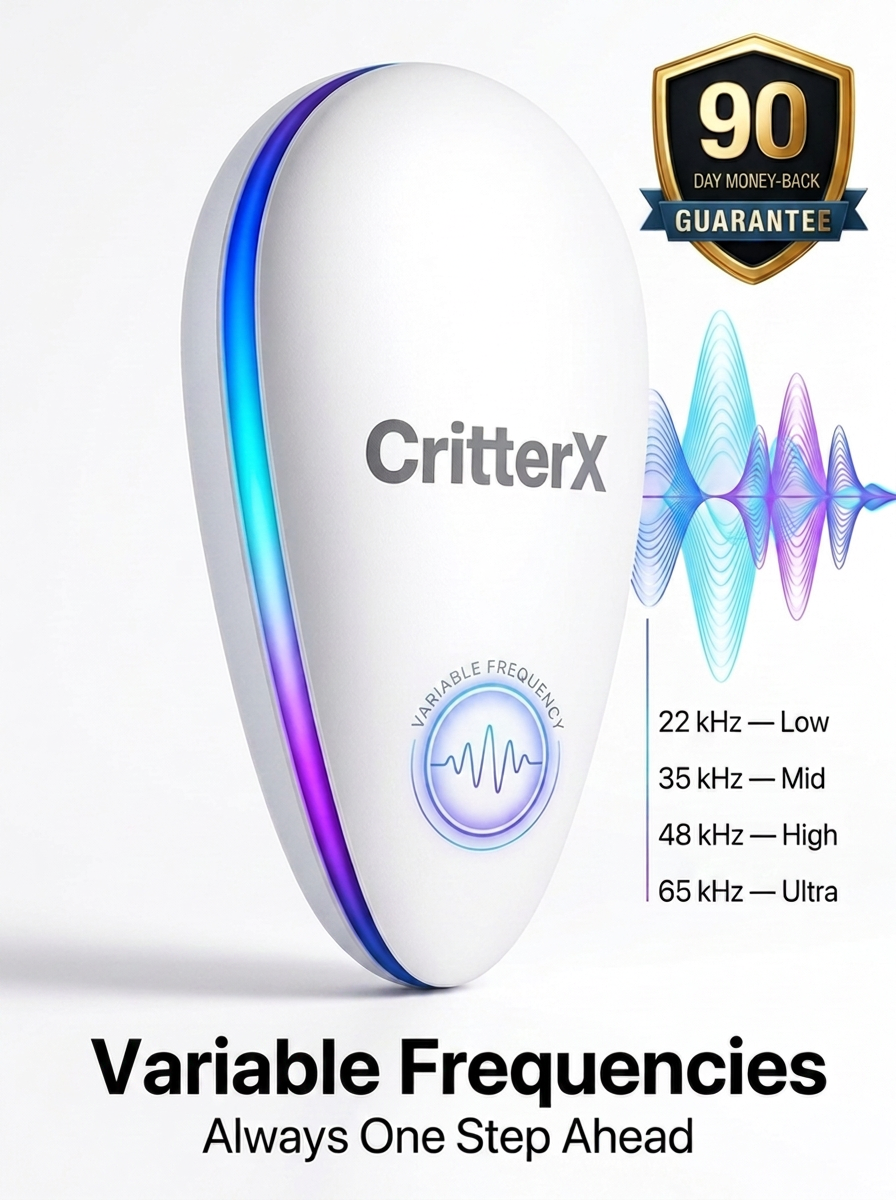
Instead of one constant tone, variable-frequency sweep technology cycles through multiple frequency ranges (22-65 kHz) in randomized, unpredictable patterns. The signal never stays still long enough for pests to adapt to.
Hospitals have used this technology in surgical wards since the 1980s — because chemical pesticides would contaminate operating rooms. Food processing plants use it because pesticides can't legally touch food. Pharmaceutical clean rooms use it because the FDA mandates zero contamination tolerance.
Commercial installations cost $8,000-$12,000 per facility. The technology was never marketed to consumers because there was no commercial incentive to compete with $20 Amazon plug-ins.
Until CritterX.
The Technical Spec That Makes The Difference
Let me show you exactly what's inside CritterX — and what's not inside the cheap devices.
Compare those specs to what's inside a $20 Amazon device:
- Single fixed frequency (typically 22 or 25 kHz)
- No sweep pattern — emits the same tone continuously
- Cheap ceramic buzzer instead of engineered transducer
- ~2 year lifespan before component failure
- No engineered coverage rating (marketing claims only)
The difference is the same as comparing a kazoo to a concert violin. Technically both produce sound. But only one is engineered to actually do something useful.
How Variable-Frequency Sweep Actually Works
Here's the mechanism in plain English.
Insects, rodents, and arachnids don't have ears like humans do. They navigate, communicate, and reproduce using a combination of vibration sensing, chemical signaling, and sound waves in specific frequency ranges. Disrupt those frequencies — and you disrupt their entire biology.
CritterX targets four distinct biological systems with four different frequencies:
The device doesn't sit on any one of these frequencies for long. It sweeps through them in a randomized pattern — switching frequencies before any species has time to adapt. The unpredictability is the entire point.
The frequencies are all above 20 kHz — which means they're completely inaudible to humans, dogs, and cats. The hearing range of dogs tops out around 45 kHz for puppies and 25 kHz for adults, but the energy levels we use are calibrated specifically to disrupt pest biology without causing distress to pets at any frequency in our range.
Why This Is Safer Than Chemical Flea Treatments
This is the part most pet owners care about most — and it's worth understanding the contrast.
Chemical flea treatments work by introducing toxic compounds into your pet's body that kill fleas and ticks when they bite or contact the chemical. The most common active ingredients are isoxazolines (Bravecto, NexGard, Simparica, Credelio), fipronil (Frontline), and imidacloprid (Advantage, Seresto).
When you apply Frontline or give your dog a Bravecto chewable, you're not poisoning the fleas directly. You're poisoning your pet with a controlled dose of pesticide that's small enough not to immediately kill the pet, but large enough to kill insects that bite them.
- Active ingredients bioaccumulate in fatty tissue over time (Bravecto's fluralaner has a 12-day half-life)
- FDA Class Warning issued in 2018 for neurological reactions including seizures
- Over 105,000 documented adverse events in FAERS database across isoxazoline class
- Linked to 2,500+ pet deaths from Seresto collars per 2021 USA Today investigation
- Requires monthly application for life of the pet — continuous chemical exposure
The fundamental problem with chemical treatments: your pet is the chemical delivery system. There's no way to kill fleas without first putting the chemical into your pet.
Variable-frequency sweep technology eliminates this entire problem.
CritterX doesn't introduce anything into your pet's body. It modifies the environment around your pet to make it uninhabitable for pests. The frequencies disrupt insect biology while remaining inaudible and biologically irrelevant to mammals.
No bioaccumulation. No bloodstream exposure. No neurological side effects. No adverse event reports. No half-life calculations to worry about. The device protects your pet by changing the space they live in — not by poisoning them with controlled doses of pesticide.
Side-By-Side Comparison: The Three Options
Here's how the three pest control approaches stack up across the criteria that actually matter:
The chemical treatments work — but at a real cost to your pet's body. The cheap ultrasonic devices don't work at all. CritterX uses fundamentally different engineering to deliver the safety profile of "doing nothing" with the effectiveness of medical-grade pest control.
The Components Inside CritterX (And Why They Cost What They Do)
People often ask me why CritterX can't be sold for $20 like the Amazon devices. The answer is the components.
A $19 Amazon ultrasonic device contains about $3 worth of internal hardware:
- A cheap ceramic piezo buzzer (the kind in greeting cards that play music)
- A single-frequency oscillator circuit
- An LED indicator light
- A plastic shell
That's it. There's no engineering in those devices because there doesn't need to be — they're not designed to actually work. They're designed to look like they work long enough for the return window to close.
CritterX uses fundamentally different components, sourced from the same suppliers that build commercial pest control systems:
The cost difference between $3 of cheap components and $20-25 of commercial-grade components is what makes the difference between a device that doesn't work and a device that does.
We sell CritterX at $39.99 not because we couldn't charge more — commercial installations of the same technology cost thousands — but because the goal was to bring this technology to regular pet owners for the first time in 40 years.
CritterX Pro Advanced Pest Repeller
Hospital-grade variable-frequency sweep technology · 400 sq ft coverage · 4-5 year operational lifespan · No chemicals · No pet exposure · No adverse reactions
What Happens When You Plug It In
Here's the timeline you should expect based on data from our customer base of over 7,900 verified buyers:
Unlike chemical treatments, there's no monthly maintenance, no reapplication, no scheduling. You plug it in once and the engineering runs in the background. The frequency sweep operates 24/7 at less than 3 watts of power consumption — about the same as a phone charger.
And critically: pests cannot adapt. Because there's no consistent frequency to adapt to, the device continues working at the same effectiveness in year 5 as it does in week 1.
This is the same fundamental property that makes the technology work in hospitals over 40-year deployments. Physics doesn't develop tolerance the way biology does.
Why You Won't Find CritterX At Amazon Or Walmart
Before I tell you where to get it, there's something important you need to know about counterfeits.
CritterX is only sold direct-to-consumer through our own website. We're not on Amazon. We're not on Walmart. We're not in pet stores.
We don't have the marketing budget of pharmaceutical companies. We can't afford to pay vets $200 per prescription the way Bayer and Elanco do. We just make the device, sell it direct, and rely on word-of-mouth from pet owners who've stopped putting chemicals on their animals.
Get The Technology Hospitals Have Used For 40 Years
Variable-frequency sweep (22-65 kHz) · 400 sq ft coverage · 4-5 year lifespan · No chemicals · No pet exposure · 90-day money-back guarantee
A Personal Note From David
I spent 15 years installing $10,000 commercial ultrasonic systems in hospitals, food processing plants, and luxury boarding kennels. Every installation, I'd watch facility managers solve their pest problems completely — without using a single chemical.
And every time, I'd think the same thing: Why is this technology locked away from regular pet owners?
The answer was simple economics: there was no incentive to compete with $20 Amazon plug-ins or with a $15-billion-per-year chemical flea treatment industry. The commercial companies were happy charging $10,000 per installation. The pharmaceutical companies were happy selling monthly prescriptions.
The pet owners stuck between cheap garbage and bloodstream chemicals didn't have a voice in the equation.
CritterX exists because I got tired of telling pet owners they couldn't access this technology. We spent three years reverse-engineering commercial systems into a consumer-priced device that uses the same fundamental engineering — same variable-frequency sweep, same DSP-driven signal processing, same hospital-grade piezoelectric transducers.
Just sized for a home instead of a 50,000 square foot facility.
You don't have to choose between chemicals in your pet's bloodstream and devices that don't work. There's a third option. And now it's finally affordable.